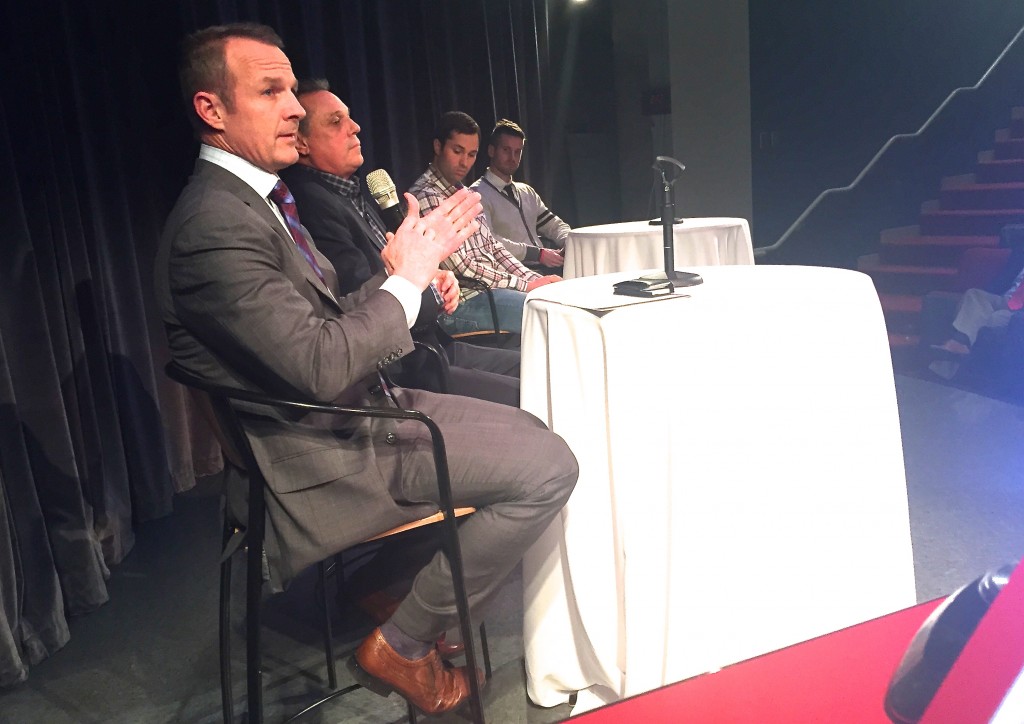
Merril Hoge, Pierre Larouche, Neil Walker and Jason Kutney at Carnegie Science Center. — DEJAN KOVACEVIC
DEJAN KOVACEVIC, DK ON PITTSBURGH SPORTS
There’s a first for everything, and moderating an Allegheny Health Network symposium on concussions Wednesday at the Carnegie Science Center was a first for me. And I mean of any kind.
But it turned out really cool, and not just because of the wealth of knowledge directly from some of the nation’s foremost specialists in brain trauma but also because of the passionate words of the panelists I moderated in the final segment: Merril Hoge of the Steelers and ESPN, Neil Walker of the Pirates, Pierre Larouche of the Penguins and Jason Kutney of the Riverhounds.
Here’s one highlight from each of those four:
Hoge, when I asked about the disproportionate focus on the NFL in this area: “If you go back just 20 years, if you go back to 1994 and asked all the great minds in this room, ‘What did you know about concussions?’ Based on what you know now, it would be astronomically different. So we can spend our time slinging mud at things or target football as a lot of people have done, or we can take the information we know right now and apply it. How do we apply that in the NFL, in youth football and in all activities? When Junior Seau died, everyone targeted football. The message was, if you play football, you’ll get a concussion and die. And I will say that my employer, ESPN, was one of those that sent out the wrong messaging. People need to get educated. They need to look at the real numbers, the real information that we have now. What they can’t do is say, ‘My child will never play football,’ then let their kid take off on a bike without a helmet.”
Walker, on the concussion incurred in 2010 when he and Ryan Church collided heads in Oakland: “I consider myself fortunate, honestly, that it took that long to have my first. I played a lot of different sports, including football, basketball and soccer. So maybe that’s why my first thought when it happened — I was out for 5-10 seconds – was, ‘Hey, did we make the out?’ The next thing I remember was the athletic trainer asking me, ‘Who pitched tonight?’ Then, just to see if I still had a sense of humor, he asked, ‘Who should have pitched tonight?’ I spent the night in the hospital in Oakland, and it took another three days before I could resume activities. But I feel lucky. I remember Ryan Doumit and … man, this was a tough, tough guy who was getting hit in his catcher’s mask game after game. And it got to the point where there was no telling how one hit affected the next, or even if a small foul tip was going to make it worse. He had to take time off, and he didn’t like it. But he was lucky to have had great doctors overseeing everything.”
Larouche, when I asked about being one of the few NHL players wearing a helmet as a rookie in 1974-75, the first year the league mandated them at the entry level: “We’ve all gotten our bell rung, everyone up here. When I skated back to the bench, they’d ask how I was, I’d say, ‘I was fine.’ You’re afraid to lose your job. You had to be tough. So yeah, when I played and had the helmet, I heard about that. You were … soft, I guess is the word you’d use. But listening to these great doctors tonight, I look back to even when I was 12 and not being able to sleep because my head wasn’t right after I went into the boards … the next day, your mom and dad and coach ask if you’re OK. You said, ‘Yes!’ You didn’t feel good for a week or two, but nobody knew. And it’s so, so serious. Look what happened to Sidney Crosby. Take care of your kids, my friends.”
Kutney, when I asked about the exposure of soccer players’ heads as active weapons and in 50/50-ball air collisions: “There are right and wrong ways to strike a soccer ball with the head, and we preach that not only to the kids in our academy but also to our pro players. If you don’t hit it right, you’re going to feel that uneasiness every time. So it’s critically important. But the culture is, too. We saw scenes in the World Cup where players were sent back in even after you could see the trainer saying no. It’s a sport where you have very limited substitution, so a coach doesn’t want to make that move too early in a match. They’d rather play short-handed for a spell and wait for that player to be ready than to substitute. That has to change. A lot has to change.”
Full disclaimer: I was paid to moderate the event, and Allegheny Health Network is a site sponsor, but the decision to type this up for you was mine alone. Hope you found it interesting.





























































November 13, 2014
Hoge, Walker laud concussion advancements
by Dejan Kovacevic • Columns • Penguins, Pirates, Riverhounds, Steelers
Merril Hoge, Pierre Larouche, Neil Walker and Jason Kutney at Carnegie Science Center. — DEJAN KOVACEVIC
DEJAN KOVACEVIC, DK ON PITTSBURGH SPORTS
There’s a first for everything, and moderating an Allegheny Health Network symposium on concussions Wednesday at the Carnegie Science Center was a first for me. And I mean of any kind.
But it turned out really cool, and not just because of the wealth of knowledge directly from some of the nation’s foremost specialists in brain trauma but also because of the passionate words of the panelists I moderated in the final segment: Merril Hoge of the Steelers and ESPN, Neil Walker of the Pirates, Pierre Larouche of the Penguins and Jason Kutney of the Riverhounds.
Here’s one highlight from each of those four:
Hoge, when I asked about the disproportionate focus on the NFL in this area: “If you go back just 20 years, if you go back to 1994 and asked all the great minds in this room, ‘What did you know about concussions?’ Based on what you know now, it would be astronomically different. So we can spend our time slinging mud at things or target football as a lot of people have done, or we can take the information we know right now and apply it. How do we apply that in the NFL, in youth football and in all activities? When Junior Seau died, everyone targeted football. The message was, if you play football, you’ll get a concussion and die. And I will say that my employer, ESPN, was one of those that sent out the wrong messaging. People need to get educated. They need to look at the real numbers, the real information that we have now. What they can’t do is say, ‘My child will never play football,’ then let their kid take off on a bike without a helmet.”
Walker, on the concussion incurred in 2010 when he and Ryan Church collided heads in Oakland: “I consider myself fortunate, honestly, that it took that long to have my first. I played a lot of different sports, including football, basketball and soccer. So maybe that’s why my first thought when it happened — I was out for 5-10 seconds – was, ‘Hey, did we make the out?’ The next thing I remember was the athletic trainer asking me, ‘Who pitched tonight?’ Then, just to see if I still had a sense of humor, he asked, ‘Who should have pitched tonight?’ I spent the night in the hospital in Oakland, and it took another three days before I could resume activities. But I feel lucky. I remember Ryan Doumit and … man, this was a tough, tough guy who was getting hit in his catcher’s mask game after game. And it got to the point where there was no telling how one hit affected the next, or even if a small foul tip was going to make it worse. He had to take time off, and he didn’t like it. But he was lucky to have had great doctors overseeing everything.”
Larouche, when I asked about being one of the few NHL players wearing a helmet as a rookie in 1974-75, the first year the league mandated them at the entry level: “We’ve all gotten our bell rung, everyone up here. When I skated back to the bench, they’d ask how I was, I’d say, ‘I was fine.’ You’re afraid to lose your job. You had to be tough. So yeah, when I played and had the helmet, I heard about that. You were … soft, I guess is the word you’d use. But listening to these great doctors tonight, I look back to even when I was 12 and not being able to sleep because my head wasn’t right after I went into the boards … the next day, your mom and dad and coach ask if you’re OK. You said, ‘Yes!’ You didn’t feel good for a week or two, but nobody knew. And it’s so, so serious. Look what happened to Sidney Crosby. Take care of your kids, my friends.”
Kutney, when I asked about the exposure of soccer players’ heads as active weapons and in 50/50-ball air collisions: “There are right and wrong ways to strike a soccer ball with the head, and we preach that not only to the kids in our academy but also to our pro players. If you don’t hit it right, you’re going to feel that uneasiness every time. So it’s critically important. But the culture is, too. We saw scenes in the World Cup where players were sent back in even after you could see the trainer saying no. It’s a sport where you have very limited substitution, so a coach doesn’t want to make that move too early in a match. They’d rather play short-handed for a spell and wait for that player to be ready than to substitute. That has to change. A lot has to change.”
Full disclaimer: I was paid to moderate the event, and Allegheny Health Network is a site sponsor, but the decision to type this up for you was mine alone. Hope you found it interesting.