March 2, 2015
Column: Penguins build on strength, not size
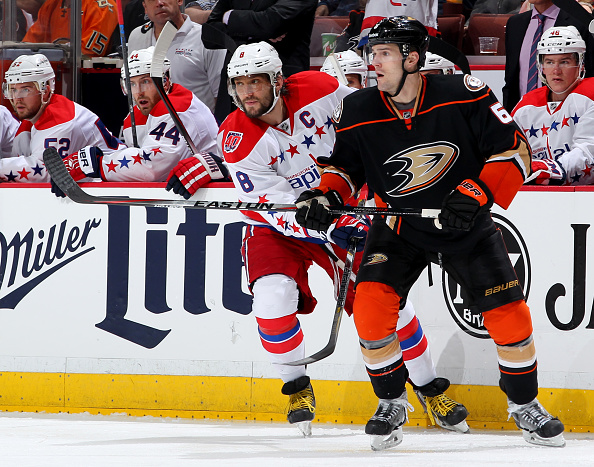
Ben Lovejoy checks the Capitals’ Alexander Ovechkin in a Feb. 15 game at the Ducks’ Honda Center. — GETTY
BY DEJAN KOVACEVIC
Let’s start with the most cynical summation possible for Jim Rutherford’s performance at the NHL trade deadline today: The Penguins, a well-below-average physical team, traded away their top two hitters, Simon Despres and Robert Bortuzzo, for two other defensemen, Ben Lovejoy and Ian Cole, who skate more swiftly and make prettier plays.
Sound about right?
Well, sure, it sounds so right that it probably isn’t cynical at all. Rutherford did part with his most physical defenseman — check that, his only physical defensemen — and he did replace them with two more of what he already held in plentiful supply. That’s not opinion. That’s cold, hard truth.
Oh, and what’s more, in the more significant deal, he sent a 23-year-old, theoretically up-and-coming player in Despres to the Ducks for a 31-year-old thoroughly known commodity in Lovejoy.
Not even the GM himself would dispute any of the above.
Nor, apparently, will he apologize for it.
“When we looked at our defense, we wanted to upgrade our experience,” Rutherford was telling the assembled media at Consol Energy Center shortly after consummating not one but two trades after he’d already stated that cap constraints were likely to keep him from making any on this day. “We liked what we saw of our defense at times, but if you go back to last summer and remember that, in free agency, this team lost two defensemen in Brooks Orpik and Matt Niskanen who had a lot of experience. We felt like we wanted to get some of that back.”
Regarding any regrets over losing his biggest hitters: “No, because both guys that we got are capable of hitting. The guys we sent out are maybe more aggressive in fighting, but down the stretch, I don’t believe that’s going to be an issue. In the playoffs, it’s not that useful.”
I thought the GM handled all of his explanations well.
I’ll accept and respect all of them. As was written in the Sunday column from Consol, Rutherford’s record in Pittsburgh has been nothing less than impeccable. He’s earned the benefit of the doubt and then some.
In fact, I’ll go further and support both trades, cumulatively and in the context of what they could mean for the Penguins moving into the 2015 Stanley Cup playoffs, though not at all based on Rutherford’s reasoning related to experience.
Instead, I’ll base it on a real-world principle: Any smart business builds on its strengths.
In other words, if you’re McDonald’s and you’re selling a zillion Big Macs, don’t waste advertising dollars promoting the Quarter Pounder.
If you’re Lego, the blocks always come first, not the movies or video games.
Balance is important in hockey, but if you’re the Penguins, and almost all of your success is predicated on speed and skill, just keep building through speed, skill and puck possession.
Seriously, set down the comparison points and contract terms and age spans, and ask yourself this one simple question: When your favorite hockey team has been at its very best this winter, most recently beating contenders like the Flames, Blues, Red Wings and Capitals, what’s been the strongest suit?
Right. Skating.
I happened to have brought up this very topic the other day with Marc-Andre Fleury, and this was what he had to say: “You can see right away when we’re going to have a good game because we come out skating. That’s the kind of team we have. We do everything quickly. And when we do that, it doesn’t matter if the other team wants to hit us because they can’t catch our guys, you know?”
I’ve seen it. Last week in D.C., I watched the Capitals come out looking to pound the Penguins, as they’d done the previous week in Pittsburgh. Mike Johnston noticed it, too, later accusing Washington of “running around a lot, getting out of their game.” Well, the Penguins’ answer wasn’t to punch back. It was to skate harder. And make quicker plays. And get off quicker shots.
“I can’t say enough about how our guys responded,” Johnston said that night. “We played the way we’re supposed to play.”
Exactly.
And remember this from newcomer Daniel Winnik in the Sunday column, following the dissection of the Blue Jackets: “In this game, what got me was how quickly and smartly the D-men move the puck. You can tell that’s something they’ve really stressed. And the attack, too. I think we’re well past the day in the NHL where you can attack the opponent’s blue line with three forwards. You’ve got to have numbers. These D-men are up on almost every play. It’s part of the system. It really makes a difference in how you play.”
So cut off that aspect of the debate right there. Because this is Johnston’s team. It’s being coached in Johnston’s system that promotes speed, skill and skating in a pack. And no rational hockey mind could weigh the moves Rutherford made today and not see that the Penguins are now superior in that context that Winnik described than they were yesterday.
Or, to examine this another way, did anyone seriously think that adding some bull-horned, blood-lusting blueliner would make this corps dramatically more studly?

What’s next, an outcry for Douglas Murray II?
Sorry, but that’s not where hockey is headed, whether some realize it or not. The modern game is about speed, skill and, above all, puck possession. To be very sure, that’s Johnston’s model. And like Rutherford, I dare say, he’s earned the right in his rookie season to see it through. Lovejoy, in particular, is a much improved player over his time in Pittsburgh, as Rutherford correctly brought up.
“Most of my guys were here when Ben was here before,” he said. “He was a young guy still feeling his way in the league. Since he’s gone to Anaheim, he’s really blossomed. He’s really developed into a solid, consistent defender. Our guys felt very strong about reacquiring this player.”
Sometimes, that matters more than chalking up a W on deadline day. It isn’t about winning the trade. It’s about winning the Cup. And if there’s one player the staff wants that badly, a good GM goes and grabs him.
You must know that this is what the head coach wants, too.
Which leads me to breaking these deals down individually, a task slightly more layered.
The Cole-for-Bortuzzo trade barely merits a mention. It’s essentially an exchange of No. 7 defensemen, one that won’t move the needle much here or in St. Louis.
But giving up Despres — or maybe I should say giving up on Despres — is different.
He occasionally tantalized, occasionally vanished and, in recent weeks, looked very much like a guy heading the wrong direction in both confidence and performance. I’ve been calling for him to be a healthy scratch, and I wonder now if the only reason he stuck in lineup was for showcase purposes. And yet, he’s a former first-round pick, still young enough to mature to another level, and there’s a good chance he’ll achieve that, whether in Anaheim or beyond. I don’t doubt for a second that the drive is there after getting to know him quite well over the years. He was beginning to take on the best off-ice traits of Kris Letang and Pascal Dupuis.
This could prove to be a mistake by Rutherford. Easily.
It also might not.
See, this is now two wholly different coaching staffs who have taken Despres under their wings, and it’s now two staffs to have decided they can do without him. I know that Gary Agnew, the current defensive assistant, saw the same ceiling that Todd Reirden, his predecessor, did. I know Agnew told me as far back as last summer he was preparing to do everything in his power to help Despres find that consistency that’s long been missing from his game, just as I know Reirden was doing likewise. Neither succeeded.
What’s that saying about fooling me once, then twice?
I won’t weep for Despres’ departure. Sure, any team would welcome a more solid return for a first-round pick of whom so much was expected. But there’s also an awareness that, for every young defenseman the Penguins give up, there are three in Wilkes-Barre waiting to take their place. I’ll take my chances in the future on one of Brian Dumoulin or Scott Harrington being that guy.
And for now, I’ll take my chances on a defense built the way Rutherford and Johnston want it built for these playoffs, right now.